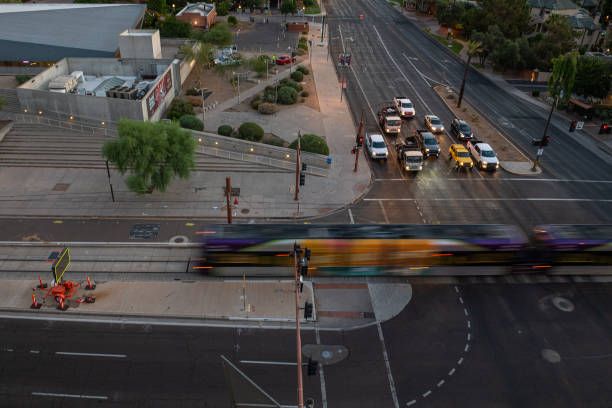
If you’re looking at homes in Central Phoenix, one of the most practical—and underrated—questions is: how easy is it to actually get around from here? Because in this part of the city, proximity to light rail, major roads, and freeways can dramatically change your day-to-day life—and your home’s long-term value.
Let’s break it down the way a local would.
Light Rail: Convenience vs. Tradeoffs
The Valley Metro Light Rail runs right through the spine of Central Phoenix, primarily along Central Avenue with key east-west connections.
The sweet spot?
Homes within about ½ mile (10-minute walk) of a light rail stop, aka between the 7’s.
That gives you easy access to Downtown Phoenix, Midtown, Uptown, Tempe, and Sky Harbor (via connection), a legitimate option to skip driving for work, events, or Suns game and stronger resale appeal, especially with younger buyers and investors
But here’s the honest part, while light rail is great and it does have some serious advantages for access to Downtown, the Airport and ASU events without the hassles of parking, it does have its limitations. Although improving, train frequency isn’t what it should be. That can mean time spent on a hot platform waiting for a train in summer. Also, despite the fact that it is expanding, it doesn’t go everywhere and it isn’t expanding fast enough. So while it is useful at the right time, it isn’t useful for every circumstance. You have to know when it is useful and when it isn’t.
🚗 Major Roads: The Grid is Your Friend (Mostly)
Central Phoenix runs on a simple grid system, which is great… until you’re sitting at your third red light in a row on Camelback.
What buyers should pay attention to:
- Living on one of these = faster commutes, but more noise
- Living 1–2 blocks off = quieter, but still highly accessible
- The 7s (7th Ave & 7th St) move traffic fast, but they’re not beginner-friendly during rush hour. Accessing business or turning in and out of neighborhoods can be a major pain. Many use streets at the half mile to avoid them
Translation: You don’t need to be on a major road—you just need to be near one.
🚙 Freeways: The Real Commute Game-Changer
This is where things get very block-specific.
Central Phoenix is framed by four major freeways:
- SR-51 (Piestewa Freeway) – your best friend if you work in North Phoenix or Scottsdale
- I-10 – connects east/west across the Valley
- Loop 202 – key for getting to the East Valley or around Downtown
- I-17 – The main route north to the northwest Valley and Northern AZ
Ideal distance?
About 5–10 minutes to an on-ramp.
That usually gives you quick regional access without freeway noise bleeding into your backyard. You will also get better flexibility if your job or lifestyle changes.
Watch out for:
- Homes too close to freeways (noise, air quality, resale hesitation)
- Homes with access issues to the freeway because of major traffic problems
Biking – the real Central Phoenix Secret
Phoenix isn’t known to be a particularly bike friendly city. We like our cars and our city was built for them. But Central Phoenix is slowly starting to buck that trend. A network of protected bike lanes have begun to pop up in Downtown and midtown. Combined with quiet side streets you can move around by bike a lot more than expected. Add the growing ebike trend and longer distances become much shorter. Add the ease of taking your bike on the light rail and those distanced get even shorter still.
The Central Phoenix Reality Most People Miss
Here’s the part Zillow won’t tell you:
Two homes that are half a mile apart can have completely different:
- Commute times
- Noise levels
- Walkability
- Buyer demand
That’s why locals obsess over micro-location.
A house that is:
- A quarter mile from light rail
- 2 blocks off Camelback
- 7 minutes from the 51
…is going to live very differently (and often appreciate better) than one that misses those marks by just a bit.
💡 What I Tell My Buyers
If you’re buying in Central Phoenix, aim for the “accessibility sweet spot”:
- Close enough to light rail to use it
- Near (but not on) a major road
- Within 10 minutes of a freeway
That combination gives you:
- Daily convenience
- Better resale flexibility
- A neighborhood feel that still feels livable
Bottom Line
In Central Phoenix, transportation isn’t just about getting from Point A to Point B—it directly impacts your lifestyle, your stress level, and your property value.
And unlike square footage or finishes, you can’t change location later.
So when you’re evaluating a home, don’t just ask “Is this a nice house?”
Ask: “How does this location actually work for my life?”
 Real Estate in Central Phoenix
Leave a comment